Manchester canals and industrial heritage - a walking guide
The water and the warehouses that made Manchester: a route through the city's working past.
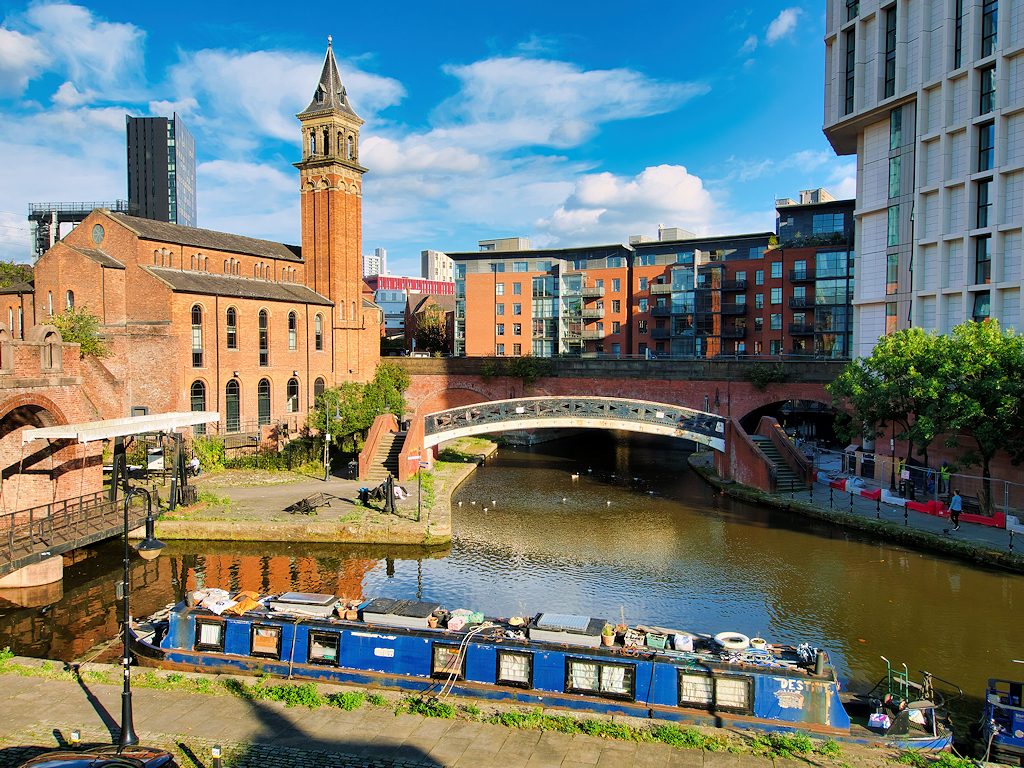
Walk Manchester's canals and mill districts to see how coal, cotton and railways remade the city. This guide covers Castlefield basin, the Rochdale Canal, Bridgewater Canal, Ancoats mills and the Science and Industry Museum site, with what each was built for, what survives and what to notice on foot.
Castlefield canal basin
Castlefield is where Manchester's canal story meets its Roman past. The basin sits beside the site of Mamucium, the Roman fort, and later became a working canal basin where boats turned, loaded and unloaded. Warehouses, locks, canal arms and railway viaducts survive in the urban park. Walk the water's edge and look for the junctions of canal arms, the stone warehouses, the Roman fort remains and the railway viaducts crossing overhead. The point of the basin was practical: space for boats and cargo close to the city centre.
Bridgewater Canal and the coal route
The Bridgewater Canal was built to move coal from the Duke of Bridgewater's mines at Worsley into Manchester. Opened in 1761, it is one of the landmark canals of the Industrial Revolution. On foot, follow the towpath and look for the canal's straight, engineered line, stone bridges and the later crossing where the Bridgewater passes over the Manchester Ship Canal at Barton. The canal shows how water transport could be designed around a single commodity: coal for industry and heating.
Rochdale Canal through the city
The Rochdale Canal was built as a trans-Pennine route, linking Manchester with Sowerby Bridge and the Calder Valley. It opened in 1804 and carried goods such as coal, textiles and raw materials across the Pennines. In Manchester, walk the towpath through locks, bridges and former warehouse districts. Look for the lock flights, cobbled setts, canal-side mills and the tight urban course where the canal cuts through the city. The canal's 91 locks show the engineering needed to cross high ground.
Ancoats mills
Ancoats became one of the world's first industrial suburbs, built around cotton mills powered by steam. The mills were constructed for spinning and weaving cotton, and the district grew with housing, canals and workshops. Today, former mills survive as converted buildings around streets such as Cutting Room Square. On foot, look for brick mill facades, tall chimneys or chimney bases, canal branches, loading doors and the grid of streets laid out for workers and freight. The surviving buildings make the scale of cotton production visible.
Science and Industry Museum and Liverpool Road station
The Science and Industry Museum stands on the site of Liverpool Road station, the Manchester terminus of the Liverpool and Manchester Railway, opened in 1830. That railway was the first inter-city passenger railway. The site was built as a railway terminus, with warehouses, platforms and goods handling. What survives includes the 1830 station buildings and the 1830 Warehouse. Walk the site and look for the early railway architecture, the warehouse scale, and the relationship between rail lines, canals and mills. It is a place to read Manchester's shift from canal power to steam railway.
How to link the walks
A practical route links the sites without needing transport between every stop: Start at Castlefield basin for canals, viaducts and Roman remains Follow the Bridgewater Canal towpath west or east for the coal-route story Return through the city centre and join the Rochdale Canal for locks and mill-side walking Walk north-east to Ancoats for cotton mill streets and converted buildings Finish at the Science and Industry Museum site for railway and warehouse architecture
This order keeps the industrial story in sequence: coal by canal, cotton in mills, then steam railway.
Frequently asked questions
What was the Bridgewater Canal built for?
The Bridgewater Canal was built to carry coal from the Duke of Bridgewater's mines at Worsley into Manchester. It opened in 1761 and became a model for later British canals.
Why is Ancoats important in industrial history?
Ancoats grew as an industrial suburb around cotton mills, canals and worker housing. Its surviving mill buildings show how steam-powered cotton production shaped Manchester's streets and economy.
What happened at Liverpool Road station?
Liverpool Road station was the Manchester terminus of the Liverpool and Manchester Railway, opened in 1830. It is widely recognised as the world's first inter-city passenger railway station, and its buildings survive on the museum site.
This is an independent member's guide compiled by Manchester Society. We are not affiliated with the venues and institutions mentioned; opening arrangements and programmes change - always confirm details on the official websites before making plans.
← Back to Events