The historic libraries of Manchester - a member's guide
A neo-Gothic cathedral of books, a medieval reading room and a circular landmark.
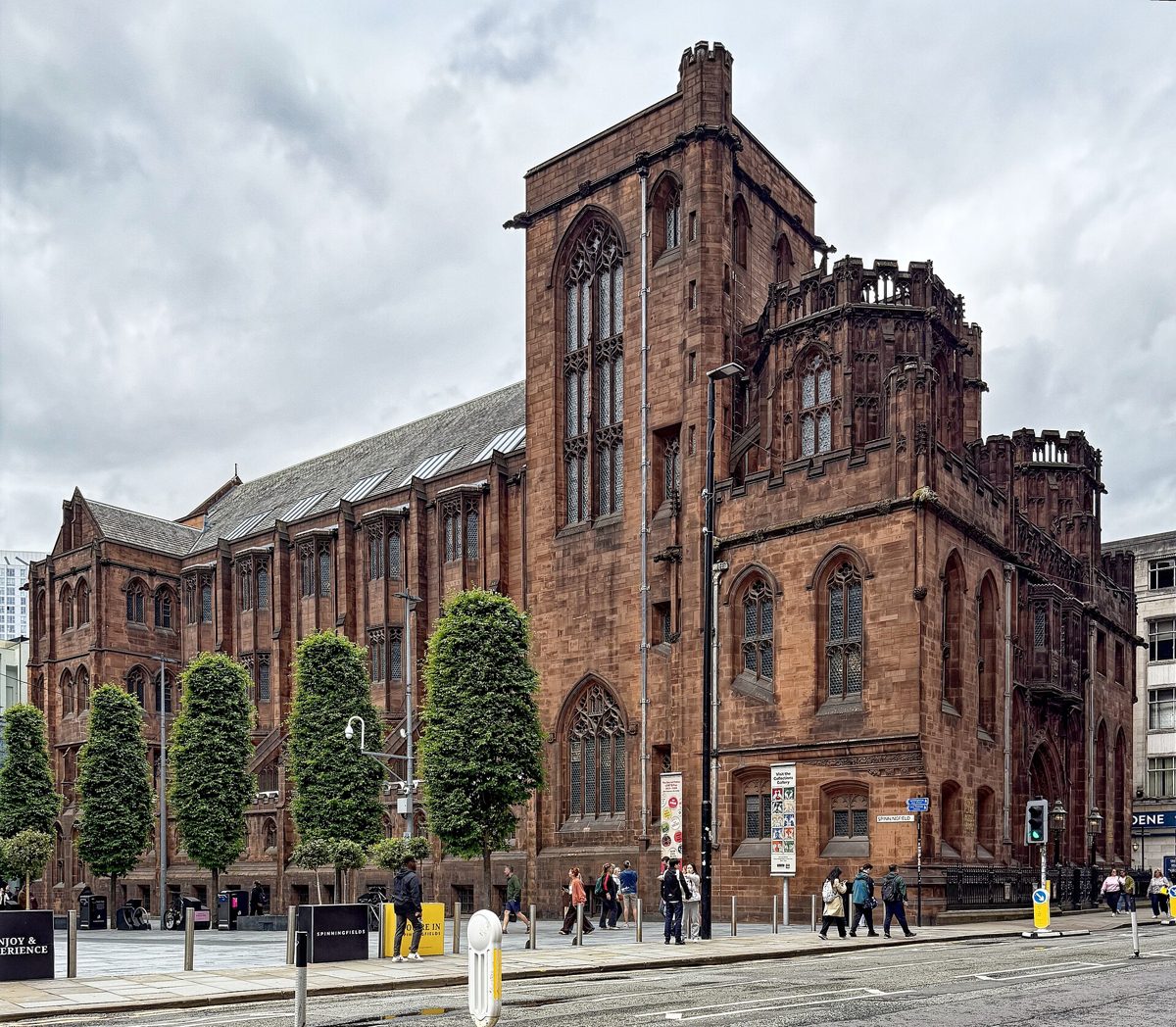
Manchester's historic libraries are not interchangeable reading rooms. Each has a different building, collection, and membership culture. This guide covers five real institutions: the John Rylands Library on Deansgate, Chetham's Library, the Portico Library, Manchester Central Library, and the Working Class Movement Library in Salford. The aim is practical orientation, not hype.
John Rylands Library on Deansgate
The John Rylands Library is the city's best-known neo-Gothic library building. It was founded by Enriqueta Rylands in memory of her husband, John Rylands, and designed by Basil Champneys. Today it is part of the University of Manchester Library's special collections. Its reputation rests on rare books, manuscripts, early printed material, and papyri rather than on ordinary lending. For a member, the value lies in access to research collections, exhibitions, and a building that is itself part of the collection's setting. The library's strength is depth: medieval manuscripts, early printed books, and archival material sit alongside later literary and religious collections.
Chetham's Library
Chetham's Library is closely tied to the medieval buildings of Chetham's School of Music. It is one of the oldest surviving public libraries in the English-speaking world, with roots in Humphrey Chetham's seventeenth-century bequest. Its collections include chained books, music, local history, and early printed works. The library's wider cultural significance comes from its association with Karl Marx and Friedrich Engels. Engels lived in Manchester, and both men used Chetham's Library for research during their Manchester years. That connection makes the library more than a local curiosity; it is a place where the intellectual history of industrial capitalism can be traced through its collections and reading spaces.
The Portico Library
The Portico Library occupies a compact Greek Revival building on Mosley Street, designed by Thomas Harrison and opened in the early nineteenth century. It began as a subscription library and remains a membership institution with a strong literary character. Its collection is known for nineteenth-century literature, periodicals, travel writing, and the social history of reading. The Portico matters because it preserves a different model of library life: curated, member-focused, and rooted in the culture of the private subscription library. It is a useful contrast to larger municipal or university collections.
Manchester Central Library
Manchester Central Library is the city's principal public library building, the circular neoclassical structure in St Peter's Square designed by E. Vincent Harris. It serves a broad public role: reference collections, local studies, archives, and everyday reading. Its importance lies in scale and civic function. Where Chetham's and the Portico preserve older institutional forms, Central Library represents the twentieth-century public library as a civic monument and a working research space. For members and visitors, it is the place to begin with Manchester's published and archival record.
Working Class Movement Library in Salford
The Working Class Movement Library is in Salford and was founded by Ruth and Eddie Frow. It collects material on labour history, trade unionism, socialism, feminism, peace campaigns, and working-class culture. Unlike the older city-centre libraries, its identity is political and social rather than architectural. It matters because it preserves pamphlets, ephemera, newspapers, and personal archives that larger institutions often overlook. For researchers, it is a specialist resource; for members, it is a place where political and social history is treated as everyday material culture.
How to use these five libraries
Start with the question, not the building. Rare books, labour pamphlets, periodicals, and local archives are held in different places. Treat each institution as its own membership system. Subscription, reference, and public-library rules are not the same. Read the catalogue before visiting. Special collections often require advance notice or supervised access. Use local-studies staff. They usually know the collection's blind spots better than any guide. Keep expectations modest. Historic libraries reward slow, targeted research more than browsing.
Frequently asked questions
Which library is best for rare books?
The John Rylands Library is the natural starting point for rare books, manuscripts, and early printed material, because its special collections are built around those strengths. Chetham's Library is also important for early printed books and chained-book collections. Manchester Central Library may help with local reference material, but it is not the same kind of rare-book environment.
Which library is connected to Marx and Engels?
Chetham's Library is the one with that association. Friedrich Engels lived in Manchester, and both Marx and Engels used the library for research. The connection should be understood as part of Manchester's industrial and intellectual history, not as a single dramatic episode. It is one reason Chetham's remains internationally significant.
Can I join all of these libraries in the same way?
No. The Portico Library is a subscription library, Manchester Central Library is a public library, and the others have their own access and membership arrangements. A sensible approach is to decide which collection matches your project, then contact that library directly through its official channels. Do not assume that one membership gives access to all five.
This is an independent member's guide compiled by Manchester Society. We are not affiliated with the venues and institutions mentioned; opening arrangements and programmes change - always confirm details on the official websites before making plans.
← Back to Events