Manchester science and innovation - a walking guide
The atom, the stored-program computer and graphene: one city's unusual scientific record.
Manchester's scientific record is unusually dense for one city. This guide covers five real sites and themes that can be linked on foot or by short tram rides, with attention to what happened, what survives, and what to look at.
Ernest Rutherford at the University of Manchester
Ernest Rutherford worked at the University of Manchester from 1907 to 1919, leading the physics laboratory. His group's experiments on the scattering of alpha particles, including the work associated with Hans Geiger and Ernest Marsden, led to the nuclear model of the atom. Rutherford's Manchester period is also tied to the discovery of the proton and to the wider rise of experimental nuclear physics.
What survives is the university's scientific identity rather than a single preserved laboratory room. The campus around Oxford Road and Brunswick Street carries the institutional memory of that work, and plaques and university buildings mark the connection. What to look at: the physics and engineering buildings along the Oxford Road corridor, university heritage markers, and the way the campus still presents science as a central public mission.
The Manchester 'Baby' and the Science and Industry Museum
The Manchester Small-Scale Experimental Machine, known as the 'Baby', first ran a stored program in June 1948. It was developed by Frederic C. Williams, Tom Kilburn, and Geoff Tootill at the University of Manchester. The machine matters because it demonstrated a working stored-program computer, a principle that shaped later computing.
The Science and Industry Museum, in the Castlefield area, holds a working replica of the Baby and interprets Manchester's industrial and scientific history. What to look at: the replica itself, the surrounding displays on computing and communications, and the museum's use of former railway and industrial buildings. The site connects early computing to Manchester's wider engineering culture.
Alan Turing Memorial, Sackville Gardens
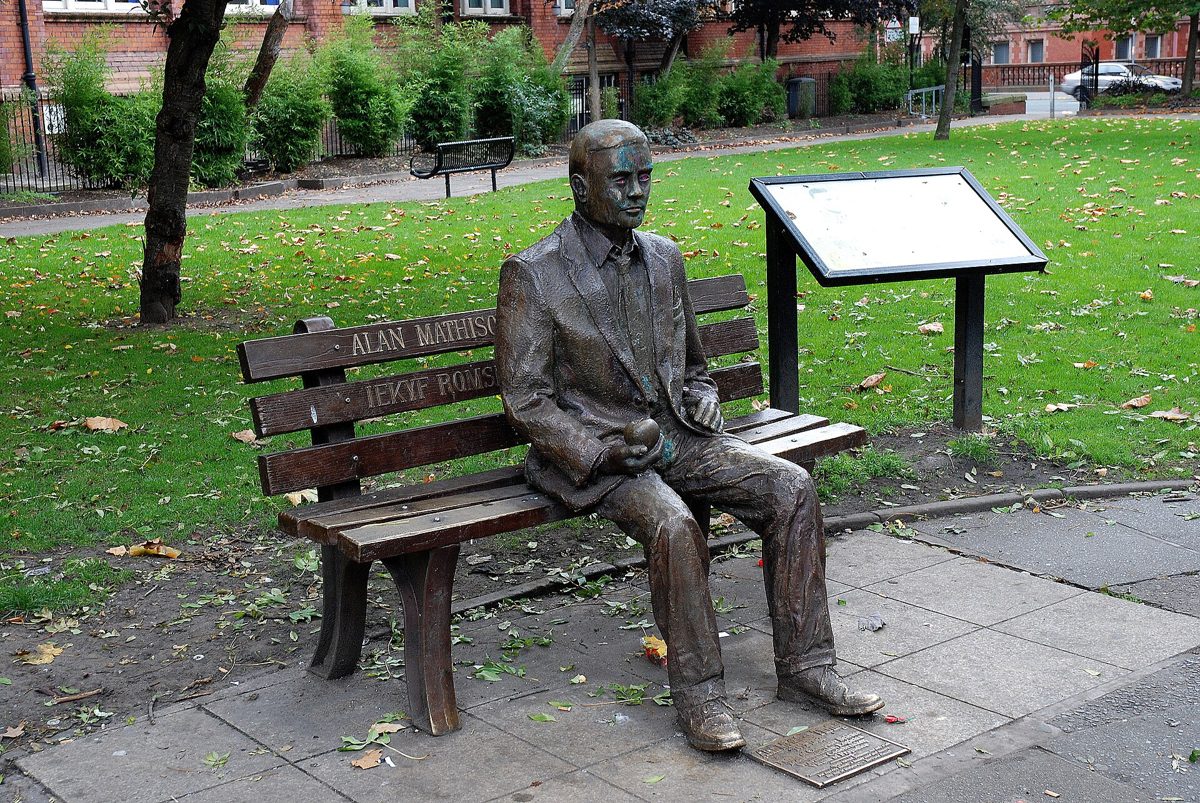
Alan Turing's connection to Manchester includes his postwar work at the University of Manchester, where he contributed to early computing and to ideas in machine intelligence. The Alan Turing Memorial in Sackville Gardens is a public sculpture and seating area dedicated to him. It is close to the university and to Canal Street, making it easy to include on a central-city walk.
What survives is the memorial itself and its place in the city's public landscape. What to look at: the bronze figure, the bench setting, and the nearby university context. The memorial is best read alongside the 'Baby' story, since both point to Manchester's early role in computing.
National Graphene Institute and the 2010 Nobel Prize
Graphene was isolated at the University of Manchester in 2004 by Andre Geim and Konstantin Novoselov. Their work was recognized with the Nobel Prize in Physics in 2010. The National Graphene Institute, on the university campus, is the research centre associated with that breakthrough and with later graphene science.
What survives is the research infrastructure and the university's continuing materials-science profile. What to look at: the institute building as part of the campus science quarter, public-facing information where available, and the proximity of physics, engineering, and materials research. The route from Rutherford's era to graphene shows a long Manchester chain in experimental physics.
Manchester Museum
Manchester Museum is the university museum on Oxford Road. Its collections include natural history, archaeology, anthropology, and Egyptology, and it serves both teaching and public audiences. It is not a single-discovery site like the 'Baby' replica, but it is part of the same civic science landscape: a university collection made available to the city.
What survives is the museum as an institution and its varied collections. What to look at: the natural history galleries, the Egyptology and archaeology displays, and the way the building sits among university science departments. It is a useful stop between the physics campus and the city centre.
Walking notes
A practical route can run from Sackville Gardens and the Turing Memorial, through the university science quarter for Rutherford and graphene, then south toward the Science and Industry Museum in Castlefield. Manchester Museum fits naturally into the Oxford Road part of the walk. Keep the route flexible, because university buildings and museum spaces change their public access arrangements over time.
Frequently asked questions
Where should I start a Manchester science history walk?
Start at the Alan Turing Memorial in Sackville Gardens, then walk toward the University of Manchester science quarter. This gives a clear central starting point and links computing history to Rutherford's physics and graphene research.
Is the Manchester 'Baby' original machine still on display?
The original 1948 machine is not the object visitors see in the usual display sense; the Science and Industry Museum is known for its working replica and interpretation of the 'Baby'. Check the museum's own information before planning around a specific object or demonstration.
What connects Rutherford, Turing, and graphene in Manchester?
All three are tied to the University of Manchester: Rutherford's nuclear physics, Turing's computing and machine-intelligence work, and the graphene research of Geim and Novoselov. The city's science story is therefore institutional as well as biographical. - Look for university heritage markers along Oxford Road. - Compare the 'Baby' replica with later computing displays. - Treat the graphene institute as part of the campus, not a separate tourist attraction. - Use Manchester Museum as a natural history and collections stop.
This is an independent member's guide compiled by Manchester Society. We are not affiliated with the venues and institutions mentioned; opening arrangements and programmes change - always confirm details on the official websites before making plans.
← Back to Events